Under Hollow Hills - A Review
Ever think about joining the circus?
Run away, disappear from this world for a spell, maybe? Perform for goblins, and kings, and friends, and a thunderstorm? Seek out the wild little things, throw the bones, step into the woods, and cut someone quick? Call on the power of performance itself to make an audience dance to your tune, or turn the clock of seasons like a wheel?
There's one stopped right over here, around the corner, if you're curious. Just step behind that shadow, hop over a laugh, fall backwards through this mirror, and join me: Under Hollow Hills.

Our first performer: Button the Fixer, the Chieftain Mouse, barks and calls our playbill!
Under Hollow Hills, from the venerable Meguey and Vincent Baker, casts its players as performers in a fairy circus. An assortment of fae folk, like the Boondoggle Hob or the Nightmare Horse, are stacked up against a few humans who have snuck their way in, such as The Interloper and The Lostling, and as a troupe you traipse across both Fairyland and The Human World, putting on the most astounding/tragic/terrifying/catastrophic/infamous show this town has ever seen, again and again and again.
Folks experienced with Apocalypse World or other games in the PbtA design lineage will recognize many familiar elements. You select one of the 13 playbooks, choose from lists that help describe who you are, ask questions that build a history between you and your fellow players, get special moves unique to you ('Plays' in this game's parlance), and when you make a play, you roll 2d6 plus a modifier, with what happens being determined by whether that total lands on 6 and below, between 7 and 9, or 10 and above. Standard stuff at this point. However...
Second: Sire Willow Briar, the Crowned Stag, with a thousand silver'd words!
In Vincent Baker's own words, "Under Hollow Hills loves to contradict conventional PbtA wisdom." Nowhere in this book will you read the phrase "To do it, do it." or anything else of that ilk. Instead, the plays here are about what approach you take to a conversation or situation. The MC1 will ask you questions such as "How are you going to play this?" or "Are you just talking, or are you going to make a play for it?" While there are certainly exciting, active plays such as "Blindfold someone" or "Summon the Mousy Clans", an overwhelming amount of them focus on internality, both your own and that of NPCs. Every session of Under Hollow Hills leads up to putting on a show, and so once you've arrived in a new location, the most important thing for your circus to do is to find out what drives the people who make up your audience. What do they crave, what do they give freely, what do they hold back, and what makes them unlike any other of their kind?
I do not want to give the impression that this game is merely walking up to fairies, asking, "Hey, what do you want?" and then giving them just that. For one, fairies aren't terribly likely to reveal their deepest desires right out. Go ahead, try and Draw Them Out. There's more than a fair chance they'll turn that play around on you and make you spill your own guts instead, or turn you into a newt (physically and/or emotionally), or wound you, or send you reeling into an entirely different world that you need to find your way back from. Secondly, everywhere you perform is an Occasion of some sort, stuffed full of its own attendees, with proceedings about to begin or already in swing. The folks here have jobs to do, exacerbations to inflict, and stories to tell. Mayhaps the circus has been invited here, mayhaps they are just passing through, but regardless, there is always a whole world to uncover, and a bevy of needy souls that can fill the seats of your circus.
Another deceptively powerful break from many other RPGs: Only one change is tracked by the character sheet. When crafting your performer, you fill two lists of imagery describing them. One describes how you look in Summer, the latter how you look in Winter, those seasons that mean so much to fairies. For humans in the circus, these qualities are instead labeled as Bold (or free or cheerful) and Careful (or wary or downcast). You start your tour in full Summer, but as you make your plays and have plays made on you, you will begin to shift back and forth between the two lists. Additionally, at the end of each session you're asked how the performance affected you and whether you'll make a step of your own in either direction.
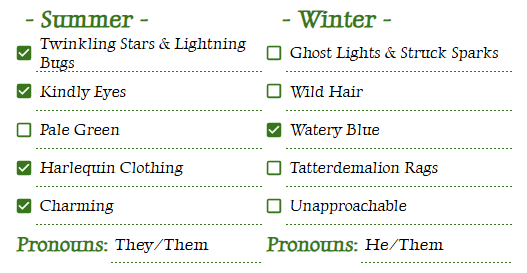 Snip from a character keeper built by Ruby Ariel Peach Saint Dennis
Every time you move across this spectrum, you slide the modifiers of your plays around to match the effect that this shift has on you. There are no experience points, and there are no "better" or more advanced forms of plays to unlock after enough sessions. This is what growth is for members of your circus, for those that travel Fairyland in performance. How your journeys mark your presentation to the world, and how you feel most and least comfortable playing it, and none of it permanent.
Third: Burning Jack, the Crooked Wand, and a mesmerizing show of magic!
I can't sing this praise loudly enough: this book is a veritable treasure trove of resources. Each occasion comes stocked with a long list of potential attendees, all with a unique purpose to play (and plays to make), more than enough that a circus could visit a dozen weddings and none of them feel the same. The rules themselves are followed by example after example, giving clear insight into how the MC might run just about any situation. A full circus performance is written up from planning to execution. Most helpfully, there's an entire chapter dedicated to timelines for the MC that describes step-by-step exactly what needs to happen for every session, from before the first time you sit down and create characters all the way to planning your tour across the realms. I regularly referred back to them in play to make sure that I was not missing some important facet, and they well cover the breadth of concerns that might arise during each moment.
Looked at coldly, it's possible to imagine that sessions might feel repetitive and restrictive in practice: Pick an occasion, pick some NPCs from the list, follow the steps, plan a circus. However, that would give short shrift to just how much energy is packed into the options laid at your feet. In the same way that Mythic Bastionland has a few score knights, a few score myths, and shockingly simple procedures for exploration, all of which combine to create a remarkably vibrant and tactile realm to traverse, Under Hollow Hills gives you more than enough to create situations crammed chock-full of fireworks that will light up the sky no matter which ones your players choose to pursue and ignite.
And of course, that's not even accounting for when the MC knows their circus best and sticks them in a place where no performance is needed at all. It's not like the plays have any less power there. They serve just as well in a duel to the death or a confession of love.
Fourth: Lavendove, the Winding Rose, and their dance of thorns!
That said, I never thought about joining the circus.
I give all this breathless praise and stand by it ardently as I follow it up with: This was not an easy game for me to run!2 I followed the rather well-trod path of starting with Dungeons and Dragons, first as a player, then as a DM, and I'd be a fool to deny it has shaped my expectations and defaults in this hobby. I love the confidence that a well prepared and envisioned scenario gives me.
While there is prep work this game asks you to do before each session (and that certainly provided me more security than games where you draw up the world and its problems in the very act of play), once the circus has been let loose in a space, predictability goes out the window. There is no Macguffin to shuffle players towards, no inexorable series of events that will inevitably change the world and demand intervention. There is merely embodying the people and the space, and allowing the players to explore them and it, so that they may decide what shape their performance will take. Once they are done taking a lay of the land, the book even admonishes the MC to "Sit back and let them plan their show! You’re there to answer questions if they have any, not to help with the plan." Trying to think of how any given stop on this circus tour "should" (or even might) look in advance would be a fool's errand.
In addition, "Can you do the thing?" is not the question of this game. On one hand, it doesn't even rely on consequences to shake up affairs, as "the game’s design just doesn’t balance on misses." On the other hand, every occasion has a reminder that the presence of this circus might ruin the events at hand, and the MC should not work to prevent that. Regardless of whether the circus is a triumph, a catastrophe, or just boring, you'll all move on to the next show. The stakes, therefore, entirely revolve around the relationships that the performers in the circus discover and build and internalize or rebuff.
So the start of each session had me terrified! Will these characters entice the circus? Is what makes them tick intriguing enough to unearth? Will the circus even care about performing for them? Every time one was too cagey, or aggressive, or otherwise put off my players, I felt like I was ill-serving them, robbing them of an audience. What sort of show could they put on without proper inspiration? Well...
And finally: Maxellinforth of the Endless Revels, the Lantern Jack,3 and their death defying aerial stride!
Somehow, despite regularly sitting in those fears, the actual circus performance was nothing short of amazing, every time.4 Here, the total imagination of the table swirls into a beautiful concoction, coalescing all the little details and desires they just stumbled across, and then adding the spice of what acts sound individually exciting to them. As one player said, "It feels like we're building a dungeon, in real time, for the MC to make their way through."
I have never felt more like Gromit laying track in front of the train he's riding on than while MCing the circus and its audience, in no small part because during the performance, each player has an opportunity to speak up and direct all the energy that a circus can conjure. At the beginning, when I spoke about controlling time and winning over an entire crowd, that was not exaggeration but rather some of the literal abilities within your grasp. The fellow players around the table then vote whether to support this act of power, and it grows in strength the more unified the show of hands is. When a table is unanimous, you can fundamentally reshape a person, a crowd, a place, even the world.
Just like art always has. Just like playing this game has done to me, in some small way. One of the things that has always drawn me to theatre, concerts, any sort of live performance, is how all of this work goes into something that vanishes into the air the second it is over. Beautifully ephemeral. To be a part of that, live, every session? I don't just mean the experience of playing a game and of imagining together, but creating an entire show, on the spot, that aims to give an audience precisely what they're lacking. It's an absolutely magical feeling. And on that note...
I see an empty spot on the playbill for tonight's show, and I have this strange feeling you might just have the perfect act for it.
Ever think about joining the circus?
Cheers and applause where it is well and truly earned:
To Meguey and Vincent Baker, for gifting us one of the purest spaces to play, for all that word can mean, as I've ever seen written down.
To the performers in Circus Yettahbenaymid, whose names mark the first four headings of this review. May your performances always be "above average."
To Quinns, and by extension, the Quinns Quest community, who have given me the chance to try out countless games I never would have otherwise, the fortune to meet wonderful folks to play alongside (including the very performers above), and the impetus to write about this activity that I love so dearly.
To alex v and Devin, for thoughtful proofreading and helpful editing advice on this piece.
🐝
The Mistress of Ceremonies, who "give[s] the circus places to perform and audiences to perform for." And while we're here: To get into how this game explores gender feels beyond the scope of my experience and what I'm confident in tackling, but if you thought a game about fairies wasn't going to run quite far with that world...ᅠ↩
I have a tendency to invoke my own experiences as demonstrative in and of themselves, with all the fortune of trying to explain a dream. I've tried to keep them out of this post, by separately writing about my experiences starting and running this game.ᅠ↩
The MC normally doesn't create a performer, but one of my players, very generously, not only commissioned illustrations of our circus, but was so kind as to include me. I was beyond thrilled to have a reason to write up a fairy of my own:
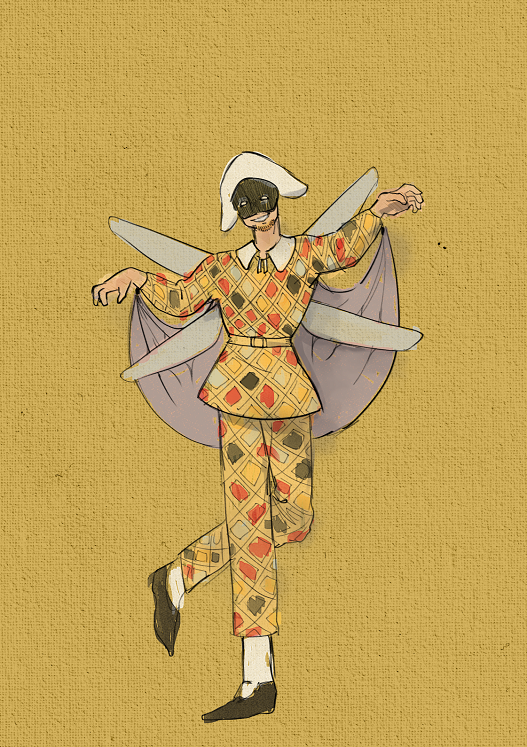 Art by nerdywhispers.Maybe they'll join the circus too someday.ᅠ↩
We played today, the day I'm publishing this review, and I was left gobsmacked, more than any time before, by how inventive and perfect every act felt. I've never been more sad that I was playing online and sans camera, because I wish the players could have seen the unrelenting joy on my face.ᅠ↩